
Micromark Alternatives for Miniature Tools
Table of Contents
- Why Makers Switch from Micromark to Other Miniature Tools Retailers
- Essential Tools for Miniature Makers: What You Actually Need
- Best Miniature Hobby Tools for Assembly and Finishing
- Hobby-Grade vs. Industrial-Grade Tools for Scale Modeling
- Budget-Friendly Alternatives Without Compromising Quality
- Quality-to-Price Ratio: Finding True Value in Miniature Tools
- Where to Source Affordable Precision Equipment
- Frequently Asked Questions
Last Updated: October 4, 2026
Why Makers Switch from Micromark to Other Miniature Tools Retailers
Finding the right supplier for miniature tools alternatives can feel overwhelming when you're juggling scale modeling projects, precision work, and budget constraints.
Makers explore miniature tools alternatives for quality and support, not just cost. The best retailers understand scale modeling, stock proven brands, and offer guidance beyond basic inventory.
This guide covers essential tools, quality comparisons, and sourcing strategies for miniature tools alternatives. Whether you're building plastic model kits, painting tabletop figures, or working with resin parts, we'll show you what to look for and where to find it.
Essential Tools for Miniature Makers: What You Actually Need
Before evaluating retailers or miniature tools alternatives, clarify what matters for your work. Most hobbyists accumulate tools randomly, then realize they own unused items while missing critical ones that would save hours.
Organize by function: precision cutting tools, clamping solutions, measuring instruments, and finishing supplies. Each serves a specific purpose in your workflow.
Precision Cutting and Sawing Tools
Cutting accuracy defines assembly quality. A clean cut requires the right tool for your material.
Hand files, hobby saws, and cutting mats form the foundation. Files shape edges and smooth surfaces; hobby saws provide control power tools can't match at miniature scale; cutting mats protect your surface and stabilize cuts.
For scale modeling, precision matters more than speed. A dull blade or wrong tool creates ragged edges that consume finishing time later.
Clamping and Holding Solutions
Holding a piece steady separates fast, clean work from sloppy results. Your hands are too large for most miniature work, and a slip costs time and materials.
Hobby clamps, small-part vises, and holding jigs do this work. The best ones grip firmly without damaging delicate pieces.
A dedicated clamping system pays for itself in reduced frustration and rework.
Measuring and Marking Instruments
Precision engineering starts with accurate measurement. Straight-edges, calipers, and marking tools ensure correct fit and matching dimensions.
Calipers measure thickness and diameter; straight-edges check flatness; marking tools transfer dimensions. These separate professional results from amateur work.
Calibration matters, a calipers off by 0.1mm compounds across multiple parts. Invest in tools from makers who understand precision engineering.
Best Miniature Hobby Tools for Assembly and Finishing
Assembly and finishing determine whether your finished piece looks amateur or professional.
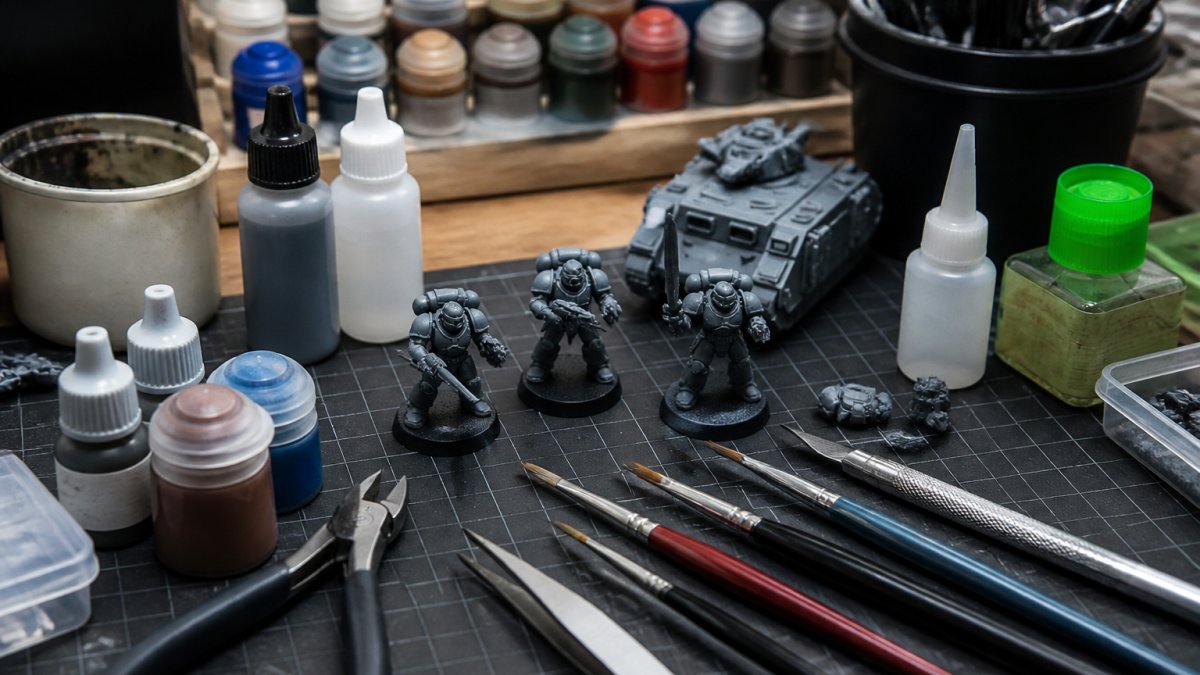
Adhesives and Gap Filling for Clean Bonds
The right adhesive for your material ensures fast, strong assembly. Cyanoacrylate works on plastic and resin; epoxy provides working time; green putty fills gaps before painting.

Green Stuff World Cyanoacrylate Glue - 20g is a precision hobby adhesive designed for modeling materials. Use sparingly, a small drop is enough for most miniature bonds.

For gaps, Green Stuff World Green Putty - 20ml fills seams before painting. Apply in controlled amounts, shape to match your surface, and sand smooth once cured.
Use less adhesive and putty in miniature work, excess creates visible joints and requires heavy sanding that damages detail.
Paint Preparation and Brush Care
Paint quality depends on surface prep and brush condition. Priming helps acrylic adhere evenly; clean brushes maintain fine points.
Green Stuff World Matt Surface Primer - 60ml prepares miniatures and models for painting. The water-based formula works with brush or airbrush application in black, white, or grey.

Green Stuff World Brush Soap - Cleaner & Preserver cleans acrylic paint and conditions bristles. Green Stuff World Brush Repair Gel reshapes bristles, maintaining fine points for detail work.
Green Stuff World Acrylic Wet Palette keeps acrylic paint workable longer, reduces waste, and lets you mix colors without drying.
Hobby-Grade vs. Industrial-Grade Tools for Scale Modeling
Hobby-grade and industrial-grade tools differ in precision, durability, and design intent.
Hobby-grade tools prioritize accuracy at small scale, sized for human hands, calibrated for miniature tolerances, and built for delicate materials.
Industrial-grade tools handle larger volumes and heavier materials. A production vise would destroy a miniature model; industrial files cut aggressively and damage fine detail.
For scale modeling, hobby-grade is the right choice, you need precision without damaging delicate parts.
The cost difference is smaller than most people expect. A quality hobby tool costs similar to industrial equipment, but it's engineered for your actual work.
Green Stuff World Cyanoacrylate Glue – 20g →
Budget-Friendly Alternatives Without Compromising Quality
Quality and affordability aren't opposites in miniature tools, but the relationship between price and performance is more nuanced than "buy cheap consumables, invest in precision tools."
The real cost of a miniature tool isn't its purchase price; it's the total time and material waste it causes. A $5 adhesive that fails mid-assembly costs you the ruined piece, the time to restart, and the frustration. A $30 clamp that holds securely for hours costs less per successful project than a $10 clamp that slips and ruins work.
Understanding True Cost Per Use
Evaluate tools by calculating their cost-per-use over their expected lifespan, not their sticker price.
A hobby file costs $12-$18 and lasts through hundreds of projects if maintained properly. That's roughly $0.01-$0.02 per use. A generic hardware-store file costs $6 but dulls after 20-30 projects due to poor tooth geometry for miniature scale.
Brush care tools illustrate this principle clearly. A brush cleaner and reshaper costs $4-$6 but extends the life of a $10-$15 detail brush by 50-100%. Without care, that brush becomes unusable in 10-15 sessions.
Consumables like sandpaper, cutting mats, and adhesive are genuinely cheaper when bought in bulk from general suppliers.
Where Price Reflects Real Capability
Some price differences reflect genuine engineering. Others reflect branding or supply-chain markup.
Adhesives and primers: Formulation matters enormously. A hobby-specific cyanoacrylate is engineered to set at the right speed for miniature work without foaming or creating visible joints.
Files and cutting tools: Tooth geometry is designed for specific materials and scales.
Clamps and holding tools: A hobby clamp has graduated pressure control so you can grip delicate resin without crushing it.
Measuring instruments: A calipers accurate to ±0.05 mm costs $12-$18. A generic calipers accurate to ±0.5 mm costs $5-$8. For miniature work where parts must fit together precisely, the difference matters.
Smart Spending Strategy
Budget allocation matters more than absolute price minimization.
- Invest in precision tools you'll use repeatedly: Files, clamps, calipers, measuring instruments. These are force multipliers that improve every project. Buy from makers who understand miniature work.
- Buy consumables strategically: Adhesives, primers, and finishing supplies are worth sourcing from specialists because formulation is critical. Sandpaper, cutting mats, and masking tape can come from general suppliers.
- Test before committing: Buy a single unit of any adhesive, primer, or putty before ordering in bulk. Material compatibility varies by project, and a $5 test saves a $50 mistake.
- Prioritize tool maintenance: Brush cleaners, file cards, and storage solutions are cheap insurance against tool degradation. A $4 brush cleaner extends the life of a $12 brush by years.
Quality-to-Price Ratio: Finding True Value in Miniature Tools
True value isn't the lowest price, it's the best outcome per dollar spent.
A $5 adhesive that works perfectly on your materials delivers better value than a $2 glue that requires rework.
Evaluate tools by what they enable you to do, not just their cost. A quality primer reduces paint failures and rework time. Brush care tools extend the life of expensive brushes.
The retailers that understand miniature tools typically offer better value than general suppliers. They stock products designed for your work, staff who know the tools, and guides that help you use them correctly. This support is worth paying for.
Where to Source Affordable Precision Equipment
Finding reliable suppliers for miniature tools alternatives requires knowing what to look for in a retailer.
The best suppliers are run by makers or closely connected to the miniature community. They understand the tools, stock what actually works, and offer guidance based on real experience.
Pewgilist exemplifies this approach. We curate supplies specifically for makers, stock proven brands like Green Stuff World, and offer custom 3D printing services for hobbyists who need specialized parts.
When evaluating any miniature tools alternatives retailer, ask:
- Do they stock brands known for quality in the miniature community?
- Can staff answer questions about material compatibility and tool selection?
- Do they offer guides, tutorials, or other support for hobbyists?
- Do they understand the difference between hobby-grade and industrial tools?
Retailers that answer yes to these questions are worth your business, even if their prices aren't the absolute lowest. The support and reliability pay for themselves through successful projects and reduced frustration.
| Tool Category | Purpose | Quality Signal | Budget Range |
|---|---|---|---|
| Precision Cutting | Shape and smooth parts | Tooth design for miniature scale | $10-$30 |
| Clamping & Holding | Secure parts during work | Graduated pressure control | $15-$40 |
| Measuring Instruments | Ensure accurate dimensions | Calibrated to tolerance standards | $8-$25 |
| Adhesives | Bond parts together | Material-specific formulation | $5-$15 |
| Primers & Finishes | Prepare surfaces for paint | Even coverage, proper adhesion | $8-$12 |
| Brush Care | Maintain tool condition | Bristle conditioning, reshaping | $3-$6 |
Frequently Asked Questions
What essential tools do I need to start miniature making if I'm new to the hobby?
Begin with precision cutting tools (hobby knife or saw), a pin vise for drilling, tweezers for handling small parts, clamping solutions, and measuring instruments like straight-edges and calipers. For finishing, add adhesives like cyanoacrylate glue, gap-filling putty, primer, and quality brushes. Green Stuff World products like their cyanoacrylate glue ($7.99) and modeling putty ($5.99) are starter-friendly. As you progress, invest in specialized tools based on your specific projects, scale modeling, miniature painting, or terrain building each require slightly different equipment.
How do I know if hobby-grade miniature tools are better than general precision tools?
Hobby-grade miniature tools are designed specifically for scale modeling tolerances, ergonomics, and material compatibility. They handle delicate work without unnecessary bulk and often include features like fine control grips. General precision tools may work but often lack ergonomic optimization for extended hand painting sessions and can cause fatigue. For miniature painting and assembly, hobby-specific tools reduce mistakes and speed up craftsmanship. Industrial-grade tools are overkill for most hobbyists and cost significantly more, making hobby-grade the smart choice for quality-to-price value.
What makes Green Stuff World products a good alternative for miniature tool supplies?
Green Stuff World specializes in hobby-specific finishing supplies that work seamlessly together. Their primer ($8.99) prepares 3D prints and models for painting, while their cyanoacrylate glue ($7.99) and modeling putty ($5.99) handle assembly and repairs. Their wet palette system ($15.99) reduces paint waste during extended sessions. Because these products are designed by makers for miniature work, they integrate well into a complete workflow. Many hobbyists find curated hobby suppliers more reliable than hunting across multiple retailers for compatible products.
How do I avoid hand fatigue when working on miniatures for long sessions?
Choose tools with ergonomic grips designed for miniature work, hobby-specific brushes and handles reduce strain compared to oversized general tools. Take breaks every 30-45 minutes to rest your hands. Use a wet palette system to reduce paint-mixing time and keep your hands in a natural position. Proper lighting and work height also matter; position your workspace so your arms rest comfortably. Green Stuff World's brush soap ($3.99) and repair gel ($5.49) help maintain tool condition, which reduces hand stress from worn or damaged equipment.
Where can I find reliable miniature tools if I want to avoid long shipping times?
Online retailers specializing in hobby supplies often stock miniature tools. Pewgilist curates a selection of miniature tools and finishing supplies from trusted brands like Green Stuff World, with a focus on quality and availability. Local hobby shops and game stores may carry basic supplies, though selection is often limited. Authorized resellers of established brands ensure you're getting genuine products with proper specifications for scale modeling and miniature painting.
Switching to a better miniature tools alternative retailer is about finding a partner who understands your craft. Pewgilist stocks professional-grade supplies curated by makers, offers guides that help you succeed, and provides custom 3D printing services for unique project needs. Shop now and discover how the right supplier elevates your builds.