
Silk PLA vs Regular PLA: Strength Comparison
Table of Contents
- What Silk PLA Is and How It Differs from Regular PLA
- Is Silk PLA Stronger Than Regular PLA?
- Silk PLA Layer Adhesion and Durability
- Silk PLA Print Settings for Optimal Strength
- Silk PLA for Functional Parts: Practical Limitations
- Silk PLA Strength vs. Regular PLA: Comparison Table
- When to Choose Silk PLA and When to Choose Regular PLA
- Frequently Asked Questions
Last Updated: October 23, 2026
What Silk PLA Is and How It Differs from Regular PLA
The core polymer in both materials is the same: polylactic acid derived from renewable resources like corn starch. The difference lies entirely in the formulation.
At Pewgilist, we stock ELEGOO silk PLA in multiple colors, including Blue/Green, Blue/Purple, Gold, and Red/Black options, each priced at $18.99 per 1 kg spool. These are designed specifically for display-focused projects where visual finish matters.

The practical implication: silk PLA trades some mechanical properties for appearance. You gain a professional-looking surface; you lose some of the toughness you'd get from regular PLA.
Is Silk PLA Stronger Than Regular PLA?
No, silk PLA is not stronger than regular PLA in the ways that matter for functional parts. But the honest answer is more useful than a one-word verdict: silk PLA is usually stiffer and more brittle, while regular PLA is usually tougher and more forgiving. Which one behaves better depends on the failure mode you care about.
What "Stronger" Actually Means
Makers use "strong" to describe at least five different properties, and silk PLA and regular PLA rank differently on each:
- Tensile strength, the peak pulling stress before the material snaps. Regular PLA generally posts higher values; silk PLA's additives tend to lower the peak.
- Stiffness (modulus), resistance to bending under load. Silk PLA is often stiffer, which sounds good until a stiff part cracks instead of flexing.
- Impact resistance, energy absorbed before fracture. Regular PLA wins clearly; silk PLA is more notch-sensitive and fails suddenly.
- Layer adhesion, bond strength between printed layers. Regular PLA bonds more reliably; silk PLA is more prone to delamination along layer lines.
- Toughness, total work to failure, combining strength and ductility. Regular PLA wins; silk PLA trades toughness for surface finish.
So the practical framing is: silk PLA is not weaker in every direction, it is less tough and less forgiving. A silk PLA bracket may feel rigid and strong right up until it shatters from a drop that a regular PLA part would have survived.
Why the Additives Change Mechanical Behavior
The glossy, color-shifting surface comes from additives and processing that alter how the polymer crystallizes and how light reflects off the finished surface. Those same formulation changes tend to reduce the material's ability to deform plastically before breaking.
This is a formulation-category effect, not a single material. Silk PLA is not one standardized polymer, it is a family of products where each manufacturer's additive package, base resin, and colorants differ. Two spools labeled "silk PLA" from different brands can behave noticeably differently in impact tests, layer adhesion, and print temperature tolerance.
What Like-for-Like Testing Would Show
Most online strength claims compare filaments printed on different machines, at different settings, in different orientations, and conditioned differently, which makes the numbers hard to trust. A fair comparison holds all of these constant:
- Same printer, nozzle, and bed
- Same layer height, wall count, infill, and orientation
- Same temperature relative to each material's recommended range
- Same conditioning (dry filament, consistent humidity)
- Same test geometry (tensile bars, flexural bars, notched impact specimens)
When practitioners run controlled comparisons this way, the pattern is consistent: regular PLA tends to win on impact and toughness, silk PLA tends to be stiffer and more brittle, and the gap widens on thin-walled or sharp-cornered parts. The exact percentages vary by brand and color, which is why qualified language beats a single headline number.
The Bottom Line
If "stronger" means survives drops, flex, and repeated handling, regular PLA is the stronger choice. If "stronger" means feels rigid on a shelf, silk PLA can feel stiffer, but that stiffness comes with brittleness. Choose based on the failure mode your part will actually experience, not on a single strength figure.
Silk PLA Layer Adhesion and Durability
Layer adhesion determines how well each printed layer bonds to the one below it. Poor layer adhesion leads to delamination: layers separate under stress, and the part fails prematurely.
Regular PLA melts and re-solidifies in a way that creates strong inter-layer bonds. The material flows smoothly between layers.
Durability over time also favors regular PLA. Silk PLA's additive package can degrade under UV exposure or prolonged heat, causing the glossy finish to dull and the material to become more brittle.
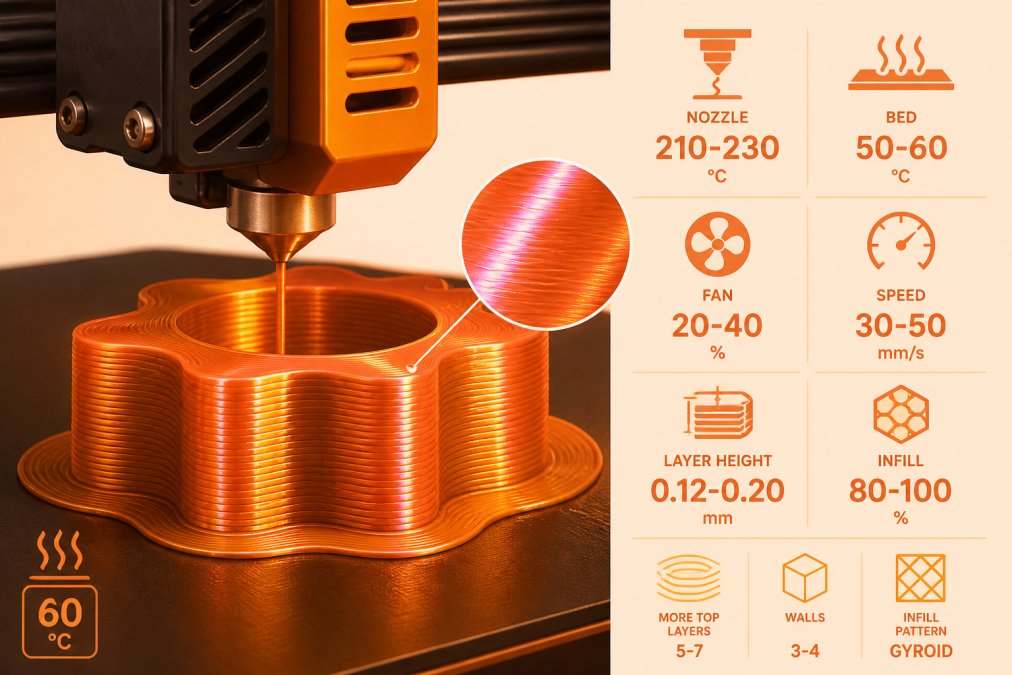
Silk PLA Print Settings for Optimal Strength
Print settings and part design can influence strength as much as the filament itself. The goal with silk PLA is not to turn it into a structural material, it is to get the most toughness the material can offer and to avoid the failure modes it is prone to: delamination, brittle fracture at corners, and thin-wall snapping.
Temperature: Strength vs. Shine
Silk PLA typically prints in the 200-220°C range, but the trade-off is real:
- Lower end (200-205°C) tends to produce better inter-layer bonding because the extrudate is cooler and the polymer has more time to consolidate before the next layer lands. Parts feel slightly less glossy.
- Higher end (215-220°C) improves flow and surface shine but can reduce layer strength if cooling is inadequate, because each layer stays soft longer.
Run a temperature tower for each new spool. Silk PLA formulations vary by brand, and the "best" temperature for one color may not transfer to another.
ELEGOO PLA Silk Filament 1 kg - Blue/Green →
Speed and Cooling
- Speed: 30-40 mm/s is a safe range for strength-focused silk PLA prints. Above roughly 50 mm/s, layers have less time to fuse and delamination risk rises.
- Cooling: 50-70% fan is a reasonable starting point. Too much cooling causes layer separation and poor bonding; too little lets layers slump and reduces dimensional accuracy. The goal is even, steady cooling, not maximum airflow.
Walls, Infill, and Orientation
These three variables often matter more than filament choice:
- Perimeters: Use at least 3 walls; 4-5 is better for any part that will see stress. A part with 4 perimeters and 20% infill is generally stronger than one with 1 perimeter and 50% infill.
- Infill: 40%+ for stressed parts; 60-100% if strength is the priority and weight is not. Infill pattern matters less than wall count for most load paths.
- Orientation: Layer lines are the weak plane. Orient the part so the primary load acts perpendicular to layer lines rather than parallel to them. This single change often does more for strength than switching filaments.
Design for Silk PLA's Weaknesses
Because silk PLA is brittle, design choices matter:
- Avoid sharp internal corners, they concentrate stress and initiate cracks. Add fillets where possible.
- Increase wall thickness at load points, thin walls under 2 mm are where silk PLA parts snap first.
- Avoid snap-fits and living hinges, these rely on flex, which silk PLA does not tolerate well.
- Add chamfers at the base, reduces peeling and layer stress at the bed interface.
Environmental and Long-Term Factors
Strength is not just a print-day property:
- Heat: Silk PLA softens at similar temperatures to regular PLA; parts left in a hot car or near a heat source can creep under load.
- UV exposure: The glossy finish can dull and the material can embrittle over time outdoors.
- Moisture: Wet filament prints weaker parts with more stringing and poor layer adhesion. Dry spools before long prints.
- Creep: Under sustained load, PLA parts deform slowly over time, a factor that matters for brackets and mounts.
Silk PLA for Functional Parts: Practical Limitations
Silk PLA is not suitable for functional parts that experience mechanical stress.
Regular PLA is better for functional parts, but even regular PLA has limits. For parts that need to survive impact, flexing, or high stress, neither PLA variant is ideal.
Silk PLA's strength limitations aren't a flaw, they're a trade-off. The material was designed for display pieces, decorative models, gaming miniatures, and visual projects where appearance is the priority.
The practical rule: if your part needs to be strong, use regular PLA. If your part needs to look amazing and strength is secondary, use silk PLA.
Silk PLA Strength vs. Regular PLA: Comparison Table
| Property | Silk PLA | Regular PLA | Winner for Strength |
|---|---|---|---|
| Tensile Strength | 40-55 MPa | 50-70 MPa | Regular PLA |
| Impact Resistance | Low | Moderate | Regular PLA |
| Layer Adhesion | Moderate | Strong | Regular PLA |
| Brittleness | High | Low | Regular PLA |
| Flexibility | Minimal | Moderate | Regular PLA |
| Glossy Finish | Yes | No | Silk PLA |
| Cost per kg | $18.99 | $13.99 | Regular PLA |
| Best Use Case | Display, decorative | Functional, structural | Depends on need |
When to Choose Silk PLA and When to Choose Regular PLA
Choose silk PLA when visual finish is the priority and the part won't experience mechanical stress.
Choose regular PLA when you need a part that will actually be used.
If you're torn between the two, ask yourself: "Will this part break if I drop it or flex it?" If yes, use regular PLA.
Choosing the right filament for your project comes down to understanding what you're actually building. If you're creating display pieces, miniatures, or decorative models, silk PLA delivers a professional finish that regular PLA can't match.
At Pewgilist, we stock both materials so you can pick the right tool for the job. Our ELEGOO PLA Silk Filament in Gold ($18.99 per kg) is perfect for trophies, awards, and decorative pieces that need visual impact. For functional parts and everyday projects, our ELEGOO PLA Filament in Black ($13.99 per kg) is the practical choice.


Frequently Asked Questions
Is silk PLA weaker than regular PLA?
Silk PLA is generally not weaker in tensile strength compared to regular PLA, but the additives that create the glossy finish can affect layer adhesion and impact resistance. The real difference lies in how you print it. Silk PLA requires precise temperature control and slower print speeds to achieve good mechanical properties. With standard PLA, you have more margin for error. For decorative prints, silk PLA performs well; for parts that take repeated stress or impacts, regular PLA is the more forgiving choice.
What makes silk PLA different from regular PLA?
Silk PLA contains additives that give it a glossy, reflective finish instead of the matte appearance of standard PLA. These additives affect how the material flows through the nozzle and how layers bond together. Silk PLA also requires higher printing temperatures (usually 210-220°C versus 200-210°C for regular PLA) and slower speeds to print cleanly. The color-shifting effect on some silk PLA products, like the ELEGOO Blue/Green and Blue/Purple options, comes from the formulation itself and shows best on curved surfaces.
Does silk PLA have weaker layer adhesion than regular PLA?
Silk PLA can have slightly weaker layer adhesion if print settings are not dialed in correctly. The additives that create the silk effect can reduce how tightly each layer bonds to the one below if cooling is too fast or temperature is inconsistent. This is why print speed and temperature stability matter more with silk PLA than with regular PLA. Slower speeds (30-40 mm/s versus 50-60 mm/s for standard PLA) and consistent nozzle temperature help maintain strong layer adhesion.
Is silk PLA suitable for functional parts?
Silk PLA is best suited to visual and presentation pieces rather than highly stressed functional components. The product listings for ELEGOO Silk PLA explicitly note that silk formulations are intended for decorative and display-focused work where appearance is the priority. If you need a part to withstand repeated stress, impacts, or mechanical loads, regular PLA or other engineering-grade materials are better choices. Silk PLA works well for cosmetic details, gaming pieces, display models, and trophies.
How can you improve the strength of a silk PLA print?
Optimize print settings to strengthen silk PLA parts: print at 210-220°C with stable temperature, slow the print speed to 30-40 mm/s, increase infill to 15-20%, use thicker walls (at least 2-3 mm), and orient the part so stress runs along the layer lines rather than across them. Avoid rapid cooling by printing in a warm environment or using a heated enclosure.
