
7 Durable Materials for Tabletop Gaming Terrain
Last Updated: October 25, 2026
Quick Summary
Durable materials for tabletop gaming terrain include PETG filament for detailed functional pieces, XPS foam for large features, and MDF for modular wargaming boards. The right material choice depends on how much detail you need, whether pieces will be moved frequently, and your time budget for finishing work.
- PETG filament offers more toughness and heat resistance than PLA, making it ideal for terrain that gets handled regularly during play.
- XPS foam is lightweight and cheap for large terrain features but requires proper sealing with primer and paint to resist surface damage.
- MDF is the standard for competitive wargaming terrain because it's stable, durable through years of handling, and accepts paint beautifully.
- Sealing foam with primer before painting is the single most important step for durability and prevents moisture absorption and uneven paint coverage.
- Hybrid approaches using foam for bulk, PETG for detailed pieces, and MDF for bases combine the speed, detail, and durability of each material.
Table of Contents
- Why Material Choice Matters for Gaming Terrain
- Comparison Table: Durable Materials for Tabletop Gaming Terrain
- PETG vs PLA for Terrain: Which Filament Holds Up
- XPS Foam Terrain: Durability and Practical Limits
- MDF Terrain for Wargaming: Strength and Finishing
- How to Seal Foam Terrain Before Painting
- Choosing Your Terrain Material: A Selection Framework
- Building Your First Durable Terrain Set
- Frequently Asked Questions
Why Material Choice Matters for Gaming Terrain
The difference between terrain that survives a season of gaming and terrain that crumbles after three sessions comes down to one decision: choosing durable materials for tabletop gaming terrain. Your choice of material shapes everything that follows, how long pieces last, how detailed you can get, how much they weigh, and whether they'll survive transport to the gaming table.
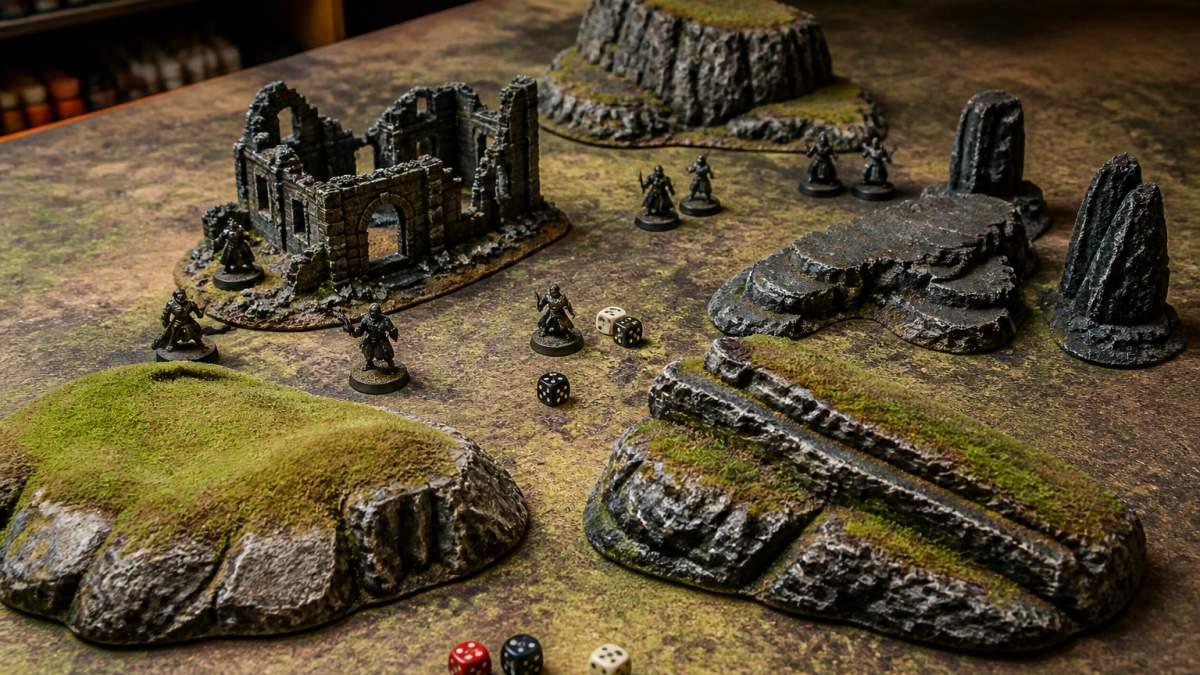
At Pewgilist, we work with makers who've learned this lesson the hard way. They've invested time painting intricate details only to watch their terrain chip, warp, or deteriorate after a handful of sessions. The right material prevents that frustration entirely.
Durability matters because gaming terrain takes real abuse. Pieces get moved, stacked, transported in boxes, and handled by multiple players. They sit under lights that generate heat. They're exposed to humidity changes and temperature swings. A material that looks great on the hobby shelf might fail spectacularly in actual play.
This guide covers the materials that hold up: 3D-printed filaments like PETG, foam solutions, and traditional wargaming materials. We'll break down what each excels at, where each falls short, and how to choose based on your specific needs.
Comparison Table: Durable Materials for Tabletop Gaming Terrain
| Material | Durability | Detail Level | Cost | Best For | Setup Time |
|---|---|---|---|---|---|
| PETG Filament | Excellent | High | Medium | Detailed, functional pieces | Moderate |
| PLA Filament | Good | High | Low | Painted display terrain | Low |
| XPS Foam | Good | Medium | Low | Large terrain features | Moderate |
| MDF | Excellent | Medium | Low | Modular wargaming boards | High |
| Resin | Excellent | Very High | High | Premium display pieces | High |
| Plaster | Fair | High | Low | Custom hand-sculpted terrain | Moderate |
| EVA Foam | Good | Medium | Low | Flexible, lightweight pieces | Low |
PETG vs PLA for Terrain: Which Filament Holds Up
PETG is the stronger choice for gaming terrain that sees regular use. It offers more toughness and heat resistance than PLA, which matters when pieces sit under bright gaming lights or get stacked in storage boxes. PLA is easier to print with and costs less, making it ideal for terrain you'll paint and display but won't handle constantly.
The real difference emerges after a few months. PLA can become brittle over time, especially if exposed to heat or UV light (Influence of UV Ageing on Properties of Printed PLA Containing Graphene Nanopowder). PETG flexes slightly under stress rather than snapping.
Print settings matter more with PETG than PLA. Learn how to calibrate PETG filament for optimal terrain printing results. You'll need a hotter nozzle and a heated bed, which most modern FDM printers handle without issue. The payoff is pieces that survive being dropped, stepped on, or squeezed into a gaming bag.
For terrain that's purely decorative and stays on a shelf, PLA works fine. For anything that gets moved regularly or touched during play, PETG wins. ELEGOO Rapid PETG Filament 1 kg in black or gray gives you durable base material that accepts paint well. If you want to experiment with PETG before committing to larger projects, the NextShapes PETG HF Refill option saves money once you have a reusable spool.


Watch out: PETG prints can warp if you rush cooling. Use a fan on low settings and let prints cool slowly inside the printer chamber for best results.
XPS Foam Terrain: Durability and Practical Limits
XPS foam (extruded polystyrene) is the standard for large terrain features because it's lightweight, cheap, and easy to carve. A single sheet costs less than a roll of filament and can become an entire mountain range.
The durability question is more nuanced than it seems. XPS foam itself lasts indefinitely, it doesn't rot or degrade in normal conditions. What breaks down is the surface. Bare foam gets dinged, dented, and scuffed with use. The edges crumble if handled roughly.
For terrain that stays on a permanent table, XPS foam is excellent. For pieces that travel to tournaments or between gaming groups, foam struggles. A single dropped corner can chip away a section of painted surface.
Foam works best in combination with other materials. Use foam for the bulk of large features, then reinforce edges and high-wear areas with harder materials. A foam mountain with a hard resin cap on the peak survives better than foam alone.
Sealing foam properly extends its life significantly. A good primer and paint system protects the surface from the minor bumps that would otherwise create visible damage.
MDF Terrain for Wargaming: Strength and Finishing
MDF (medium-density fiberboard) is the workhorse of modular wargaming terrain. It's tough, stable, and accepts paint beautifully. A sheet of MDF holds up to years of handling, stacking, and transport without visible wear if finished properly.
The tradeoff is time. MDF requires more finishing work than other materials. You'll sand edges, fill gaps, prime, and paint. A single terrain tile takes longer than a foam piece of similar size. But the result is terrain that looks professional and lasts through decades of gaming.
MDF doesn't warp like some materials do. It's stable across temperature and humidity changes, which matters if your gaming space fluctuates seasonally. Once sealed and painted, MDF is nearly indestructible in normal gaming use.
The detail level is moderate. You can carve details into MDF, but it's labor-intensive. Most MDF terrain uses paint effects and dry-brushing to create visual interest rather than carved features.
For competitive wargaming where terrain travels to events and gets reused for years, MDF is the standard choice. The investment in finishing pays off through longevity.
How to Seal Foam Terrain Before Painting
Sealing foam before painting is the single most important step for durability. Unsealed foam absorbs moisture, which leads to warping and paint adhesion problems.
Start with a primer designed for foam. A water-based primer like Green Stuff World Matt Surface Primer creates a smooth base that accepts acrylic paint consistently.

The primer does two things: it seals the foam so paint doesn't soak in unevenly, and it creates a uniform surface for paint adhesion. Foam without primer will show streaky, uneven paint coverage because different areas absorb paint at different rates.
ELEGOO Rapid PETG Filament 1 kg - Black →
After primer, acrylic paint provides additional protection. Acrylics form a flexible shell over the foam that resists cracking even if the foam shifts slightly. This flexibility is important, rigid paint over foam can chip if the foam flexes.
A final matte varnish adds another protective layer. It protects the acrylic paint from moisture and minor scuffs. Gloss varnish looks shiny on terrain, so matte is the standard choice for gaming pieces.
The whole sealing process, primer, paint, varnish, adds maybe 6-8 hours of drying time spread across a few days. That's time well spent. Sealed foam survives years of handling. Unsealed foam starts showing damage after weeks.
Choosing Your Terrain Material: A Selection Framework
Start by answering three questions: How much detail do you need? How much will the terrain move? What's your time budget?
High detail + stays in place = 3D-printed resin or PETG. Resin gives the most detail but requires more safety precautions and skill. PETG offers strong detail with easier printing.
High detail + gets moved = PETG with reinforced edges. Print in PETG, seal with primer and paint, and reinforce any thin or delicate features with epoxy putty.
Large features + stays in place = XPS foam. Fast to build, cheap, looks great when painted. Seal it properly and it'll last years without moving.
Large features + gets moved = MDF. Takes longer to finish but survives repeated handling and transport without damage.
Budget-conscious + simple shapes = PLA or EVA foam. Both are cheap and work fine for basic terrain.
Modular gaming boards = MDF. The stability and durability justify the finishing time.
Consider hybrid approaches. Many successful terrain setups use foam for bulk, PETG for detailed functional pieces, and MDF for the base or frame.
Building Your First Durable Terrain Set
Start small. A single terrain piece teaches you more about material behavior than reading about it. Learn about the essential tools required to construct and paint tabletop terrain.
If you're printing, start with ELEGOO Rapid PETG Filament in black or gray. These neutral colors work as base layers for any painted finish.
Seal your print with primer. Use Green Stuff World Matt Surface Primer and apply two coats. This teaches you how the material accepts primer and how much coverage you need.
Paint with acrylics. A basic paint set with black, white, brown, and gray lets you create convincing terrain through dry-brushing and layering. Don't aim for perfection, this is a learning piece.
Finish with matte varnish. This protects your work and shows you what the final product looks like.
Once you've finished one piece, you'll understand how much time each step takes and where the weak points are. That knowledge guides your next project.
The key is building with intention. Each piece you make teaches you something about how materials behave under your conditions, your printer, your paints, your hands.
Durable terrain starts with the right material choice, but it's finished by the work you put into sealing and protecting it. At Pewgilist, we stock the filaments and primers that makers rely on to build terrain that lasts. Shop PETG filament and terrain primers and start building terrain that holds up.
Frequently Asked Questions
What materials are best for making durable tabletop gaming terrain?
PETG filament, XPS foam, MDF, and resin are the top choices for durable materials for tabletop gaming terrain. PETG offers impact resistance and flexibility when 3D-printed. XPS foam is lightweight and carves easily but needs sealing. MDF provides structural strength for large builds. Resin creates hard, detailed pieces but requires careful handling. Your choice depends on your gaming style, budget, and desired level of detail.
Is PETG or PLA better for 3D-printed terrain?
PETG vs PLA for terrain comes down to durability. PETG is significantly tougher and more heat-resistant, making it ideal for pieces that see frequent handling or play. PLA is easier to print and cheaper, but it's more brittle and can crack under stress. For terrain that will be moved, stored, and used repeatedly, PETG is the better choice. NextShapes PETG HF and ELEGOO Rapid PETG both offer strong layer adhesion and low warping, starting at $13.99 per kilogram.
How do you seal foam terrain before painting?
Sealing foam terrain prevents paint from soaking in and creates a smooth surface for detail work. Apply a primer like Green Stuff World Matt Surface Primer ($8.99) with a brush or airbrush to create an even base. Let it dry fully before painting. For additional protection, some makers apply a thin coat of sealant or gesso before priming. This step is essential for XPS foam terrain to ensure paint adhesion and durability.
Is XPS foam durable enough for regular tabletop use?
XPS foam terrain is durable for most gaming scenarios when sealed and painted properly. It resists moisture and won't rot, and carved details hold up well. However, XPS foam terrain can chip or dent from hard impacts or repeated handling. It works best for stationary terrain pieces or display pieces. If your terrain moves frequently or gets packed in storage, PETG or MDF may be more resilient choices for high-traffic gaming.
What's the difference between MDF and foam for gaming terrain?
MDF terrain for wargaming offers superior structural strength and is ideal for large, complex builds that need to support weight. MDF is denser, won't chip as easily, and holds fine detail well. Foam is lighter, easier to carve, and better for organic shapes. MDF requires more tools to work with and produces dust during cutting. Choose MDF if durability and weight-bearing capacity matter; choose foam if portability and ease of carving are priorities.
