
Are Airbrush Paints Good for Hand Painting Miniatures?
Last Updated: November 10, 2026
Quick Summary
Yes, airbrush paints are good for hand painting miniatures, provided you thin them and control your load. They are still water-based acrylics that bond to primer and accept varnish like any hobby paint, so the adjustment is in consistency and application, not chemistry.
- Thin airbrush paint with water, airbrush medium, or flow improver until it flows like milk.
- Add airbrush medium first, then water only if the mix is still too thick.
- High pigment density gives strong coverage in fewer layers when brush painting.
- Faster drying punishes slow brushwork, so add a drop of retarder and work smaller zones.
- Start with Green Stuff World's water-based acrylic line, listed for brush or airbrush use.
Table of Contents
- Airbrush Paints vs. Standard Acrylics: What Actually Differs
- Can You Use Airbrush Paint With a Brush? Yes, With Adjustments
- Pros and Cons of Hand Painting With Airbrush Paints
- Thinning Airbrush Paint for Hand Painting
- Miniature Painting Tools for Beginners: What You Need First
- Troubleshooting Brush-Applied Airbrush Paint
- Picking Your First Bottles at Pewgilist
- Frequently Asked Questions
Airbrush Paints vs. Standard Acrylics: What Actually Differs
Yes, airbrush paints are good for hand painting miniatures, but only if you understand what makes them different. At Pewgilist, we get this question constantly from painters who bought a bottle for their airbrush and wondered whether it could pull double duty on a brush.
The short answer is that it can, and often beautifully, but the adjustment is real. Below, we'll show you exactly how to thin, load, and troubleshoot these paints so your first brush session doesn't end in a chalky mess.
Pigment Density and Binder Ratios
Pigment density is the concentration of color particles suspended in a given volume of paint. That density is your friend on a brush: fewer coats for solid coverage, and stronger color in thin glazes.
The trade-off sits in the binder. On a brush, a lean binder means the paint can dry faster and level less smoothly. Watch out: loading a dense airbrush paint straight onto a brush without thinning is the fastest route to visible brush strokes and a patchy basecoat.
Drying Time and Leveling
On a brush, fast drying is a double-edged sword. It speeds up your layering and edge highlighting, but it also punishes sloppy brushwork because the paint skins over before it can self-level.
If you're used to a wet palette with standard acrylics, expect to re-wet your mix more often. A drop of retarder or airbrush medium stretches the open time and helps the paint flow out flat.
Can You Use Airbrush Paint With a Brush? Yes, With Adjustments
You can absolutely use airbrush paint with a regular brush, provided you thin it and control your load. The paint itself is still water-based acrylic, so it bonds to primer and accepts varnish exactly like any hobby paint. The adjustment is in consistency and application, not chemistry.
Here is how we would approach a first test piece:
- Prime the model and let it cure fully before touching it
- Decant a small amount onto a wet palette rather than working from the bottle
- Thin with water or airbrush medium until it flows like milk
- Load the brush lightly and wick off excess on a paper towel
- Apply two thin coats instead of one heavy one
Golden Artist Colors' technical guidance on acrylic mediums explains how medium-to-pigment ratios affect film formation, which is the same principle at work here. A medium keeps the binder flexible and the finish even.
Pros and Cons of Hand Painting With Airbrush Paints
The honest verdict: airbrush paints reward patient painters and frustrate impatient ones. Here's the breakdown.
Pros:
- High pigment density means strong coverage in fewer layers
- Excellent for glazing and layering because color stays saturated when thinned
- One bottle covers both spray and brush work, which simplifies your paint rack
- Often smoother out of the bottle than thick standard acrylics
Cons:
- Faster drying punishes slow brushwork and causes tide marks
- Leaner binder can produce a chalky finish if over-thinned
- Some colors separate in the bottle and need thorough shaking
- Not every airbrush line is lightfast across the full range
If you're weighing whether specialty paints earn their shelf space, our breakdown of why professional paints make better minis makes the case for pigment quality over bargain bottles.
Thinning Airbrush Paint for Hand Painting
Thinning airbrush paint for hand painting means adding water, airbrush medium, or flow improver until the paint moves freely off the brush without pooling. The target consistency sits somewhere between whole milk and heavy cream, thin enough to flow but opaque enough to cover in two passes.
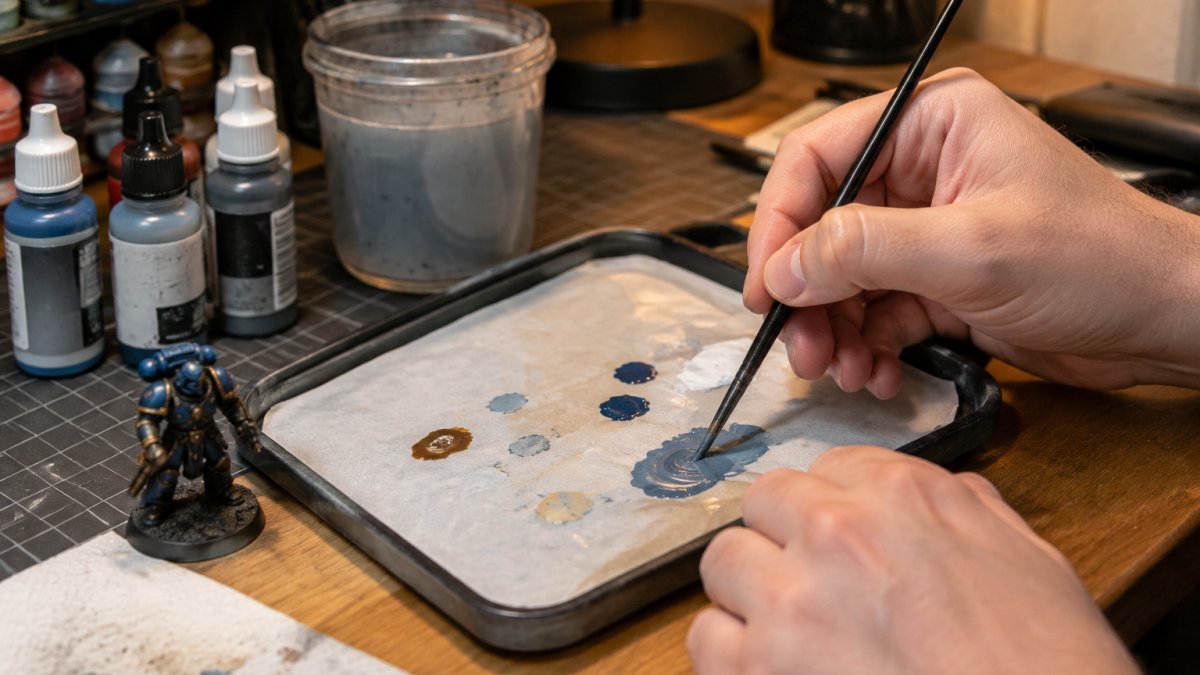
What Each Additive Actually Does
- Water lowers viscosity and dilutes everything in the bottle, including the acrylic binder. It is the cheapest thinner and the fastest route to a chalky, under-bound film if you push past roughly one part water to one part paint.
- Airbrush medium is essentially a thin acrylic binder with flow agents. It thins the paint while restoring the resin you would otherwise lose, which keeps the film flexible and the finish even. This is the additive to reach for when a mix starts looking dusty.
- Flow improver is a surfactant, not a thinner. A drop or two breaks surface tension so the paint spreads and levels instead of beading. It does not add binder, so it cannot rescue an over-thinned mix on its own.
- Retarder slows the cure so the paint stays open longer. Useful on a wet palette or in dry indoor air, but too much leaves a tacky film that never fully hardens.
A Practical Mixing Sequence
- Decant a small amount of paint onto a wet palette rather than working from the bottle.
- Add airbrush medium first and stir until the paint stops resisting the brush.
- Add water only if the mix is still too thick, a little at a time.
- Add one drop of flow improver per well and test on a primed offcut.
- Add retarder only if the paint is skinning over mid-session.
If you want to build brush control with these thinner mixes, our guide on dry brushing miniatures and 3D prints pairs well with thinned paint practice.
Miniature Painting Tools for Beginners: What You Need First
Miniature painting tools for beginners come down to a small, honest kit: two or three brushes, a wet palette, a primer, and a way to thin paint consistently. You do not need a full studio to start.
Our short list:
- A size 1 and size 0 round brush for detail, plus a larger flat for basecoats
- A wet palette to keep thinned paint workable
- A rattle-can or brush-on primer suited to your model material
- A water cup and a palette for mixing
- Good lighting, ideally a daylight lamp
If you're assembling a first kit, our rundown of the best miniature painting tools for beginners covers brushes and accessories in more depth.
Troubleshooting Brush-Applied Airbrush Paint
Chalky finishes, streaking, and uneven coverage are the three complaints we hear most, and each traces back to a specific property of airbrush-optimized paint rather than to bad luck. On a brush, those same traits change how the paint levels, dries, and layers.
| Problem | Likely Cause | Fix |
|---|---|---|
| Chalky, dusty finish | Over-thinning with water, binder diluted away | Rebuild the mix with airbrush medium instead of water |
| Paint dries on the brush | Fast-drying formulation plus small working area | Add a drop of retarder and work smaller zones |
| Uneven coverage | Paint too thick, or too little pigment per pass | Thin to milk consistency and apply two coats |
| Visible brush strokes | Under-thinned paint or overloaded brush | Add flow improver, load lighter, wick off excess |
| Streaks that reappear when dry | Retarder-heavy paint re-wetting a lower layer | Let each layer cure fully before the next |
| Clogging in the brush | Pigment settling in the bottle | Shake thoroughly and stir on the palette |
Why Airbrush Paint Behaves Differently on a Brush
Two mechanisms drive most of these problems. Second, drying time: the retarders that keep a nozzle wet also keep a brushed layer open longer than you expect, which means a second pass can drag the first one instead of sitting on top of it.
A Diagnostic Order That Saves Paint
When a mix misbehaves, work through these checks in order before adding anything else:
- Check the bottle. Shake and stir. Settled pigment is the most common cause of weak coverage.
- Check the consistency. If it does not flow off a loaded brush in a smooth line, it is too thick.
- Check the binder. If the mix looks dusty on the palette, add medium, not water.
- Check the cure time. If streaks reappear after drying, the lower layer was not fully cured.
- Check the environment. Low humidity and warm rooms shorten open time; a retarder helps there.
For a deeper look at chalky results, our guide on preventing chalky finishes in miniature paints walks through the causes step by step.
Picking Your First Bottles at Pewgilist
The best way to test airbrush paints on a brush is to start with a small, versatile set. We stock Green Stuff World's water-based acrylic line, which is listed for brush or airbrush application, so you can experiment with one range.
Our picks for a first order:
- Green Stuff World Acrylic Color Paint - 17ml at $4.49 for basecoats and layering
- Green Stuff World Metallic Paint - 17ml at $5.50 for weapons and armor trim
- Green Stuff World Chrome Paint - 17ml at $6.99 for polished display details
- Green Stuff World Fluorescent Paint - 17ml at $4.49 for glowing accents
- Green Stuff World Chameleon Colorshift Paint - 17ml at $5.99 for armor and creature effects
You can browse the full paint collection to choose your first bottles and colors.
The real test is whether your first thinned coat flows off the brush without streaking. If it does, airbrush paint just became one of the most versatile bottles on your desk. Pewgilist carries water-based acrylics built for both brush and airbrush work, plus the tools and guides to help you get the finish right the first time. Get started with Pewgilist and build a paint rack that works as hard as you do.
Frequently Asked Questions
Is an airbrush worth it for miniature painting?
It depends on what you paint and how often. An airbrush excels at basecoats, smooth gradients, and large surfaces like vehicles and terrain, cutting hours off those jobs. For small character models, detail work, and edge highlighting, a brush still does most of the job. Many painters keep both: airbrush paints for broad coverage and standard acrylics for detail. Start with brush-friendly paints and add an airbrush once basecoating becomes the bottleneck.
What is the difference between airbrush paint and standard acrylics?
Airbrush paints are pre-thinned with more medium and less pigment, so they flow through a small nozzle without clogging. Standard acrylics carry higher pigment density and a stronger binder, which gives better coverage and opacity from a brush. That pigment load is why airbrush paints can look thin or patchy when brushed on straight from the bottle, and why they often need multiple coats for solid coverage.
Do I need to thin airbrush paint for hand painting?
Usually no, and often you should not. Airbrush paints are already thin, so adding water can push them past the point where they grip the surface, causing pooling and tide marks. If a bottle feels too runny, let it sit and use a wet palette to control consistency. Only add a drop of airbrush medium or flow improver if the paint drags or dries too fast on the brush.
Can I use airbrush paints on a 3D printed miniature?
Yes, but priming the print first is a sensible step. Green Stuff World's 17ml water-based acrylic line is listed for brush or airbrush application.
Are airbrush paints good for layering and glazing?
They are excellent for glazing and layering because their low pigment load builds up gradually. You get smooth transitions and soft gradients without the chalky buildup that heavier paints can cause. The trade-off is speed: solid basecoats take more coats. Use airbrush paints for the soft blends and switch to higher-pigment acrylics when you need opaque coverage in one or two passes.
Green Stuff World paint prices per 17ml bottle
